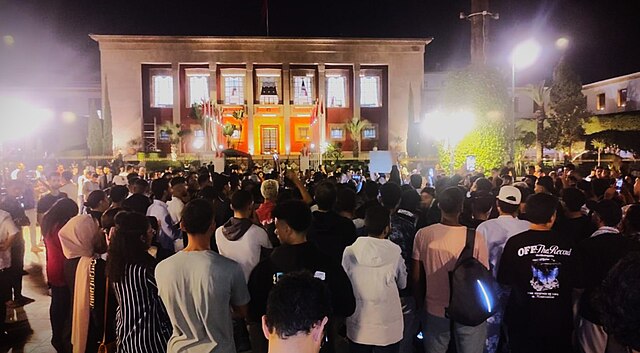
 Mounir Neddi (Wikimedia Commons)
 GenZ demonstrations in Rabat, Morocco. October 4, 2025
The African continent is home to the world’s youngest population, with 75% of its people under age 35. Thomas Sankara, the late president of Burkina Faso, once said, “It is the youth who have the fire and the courage to change the world. We must not dampen their spirits; we must fan the flames of their creativity.”
What’s Happening Now
Today, young people across the continent are actively working to change the systems their parents once trusted, but that failed to deliver. These systems have ignored them for too long, prompting them to start movements.
With the rise of digital media and an evolving political landscape in Africa, a significant wave of protests led by Gen Z has emerged, fueled by platforms like TikTok, Instagram, and X. The youth are demanding more than just symbolic representation and empty promises; they want authenticity and accountability from their leaders. They aren’t afraid to question whether their leaders’ personal politics align with principles of justice, equality, and inclusion.
Today’s African youth are becoming more curious about who among their leaders is truly committed to dismantling systems of oppression and who is only focused on maintaining their own power.
How Do We Know?
Over the past three years, protests led by Gen Z have erupted in countries such as Kenya, Morocco, Nigeria, Mozambique, Tanzania, Uganda, Cameroon, and many others.
These protests stem from deep dissatisfaction with living conditions and repeated failures of political leaders to deliver on promises of economic progress.
Issues like unemployment, rising living costs, tax hikes, corruption, unfair elections, shrinking civic space, and abductions have pushed young people to their breaking point.
Gen Z Taking the Lead
In June 2024, youth-led protests in Kenya quickly inspired similar actions in Uganda, Tanzania, and Cameroon. In Cameroon, President Paul Biya, one of the world’s longest-serving leaders, has become a symbol of political stagnation for a generation that sees no future under leaders who refuse to step aside.
Similar frustrations exist in Tanzania and Uganda, where protests are driven by concerns over corruption, rigged elections, and economic struggles. Within this context, social media influencers and digital activists play a crucial role.
They serve as gatekeepers, filtering information, framing narratives, and translating complex political issues into relatable language. Their credibility often hinges not on expertise but on shared struggles and truths that resonate with people’s everyday experiences. Their personal beliefs and values influence what they amplify, making them powerful intermediaries between institutions, the media, and the public.
Thanks to digital engagement, young people are amplifying, sustaining, and organizing protests through social media—using hashtags, livestreams, and videos.
These tools help mobilize in real time, coordinate demonstrations, counter misinformation, document police brutality, and crowdfund legal aid for arrested activists. Social media connects local struggles to the African diaspora, ensuring that violence is seen and challenged. This connectivity has also inspired protests in other African countries facing similar government challenges.
The Movement and Its Consequences
In response, governments have used police and military force, shut down internet access, carried out extrajudicial killings, made abductions, censored journalists and media, and detained activists arbitrarily.
Leaders like Tanzania’s President Samia Suluhu have even gone further, dismissing evidence of violence as “AI-generated content” and “foreign manipulation.” At the same time, many countries involved in protests are facing currency fluctuations and economic uncertainty, worsening the hardships protesters already face.
What’s Next
Ultimately, future developments depend largely on how African governments respond. Repression might silence voices temporarily, but it won’t address the underlying issues causing dissent. A generation that has grown up online, learned from global protest movements, and built transnational solidarity will not be easily intimidated.
This cycle of mutual support through digital platforms has transformed these protests from isolated national events into a broader continental dialogue.
Reference & More Information
- Amnesty International. (2025, November 26). Kenya: Authorities weaponized social media and digital tools to suppress Gen Z protests. https://www.amnesty.org/en/latest/news/2025/11/kenyan-weaponized-social-media-and- digital-tools-to-suppress-gen-z-protests/
- Bhalla, N., Adebayo, B., Harrisberg, K., & Comé, S. (2025, January 13). Africa’s youth protests: A storm brewing for 2025? Context by TRF. https://www.context.news/money- power-people/africas-youth-protests-a-storm-brewing-for-2025
- Gbadamosi, N. (2025, October 9). What’s behind Africa’s sweeping Gen Z protests. Foreign Policy. https://foreignpolicy.com/2025/10/08/africa-gen-z-protests-madagascar- morocco/
- Lawal, S. (2024, August 12). Is Africa experiencing a protest-led revolution? Al Jazeera. https://www.aljazeera.com/features/2024/8/12/is-africa-experiencing-a-protest-led- revolution
- Ngutjinazo, O. (2024, July 31). Africa is seeing more youth-led protests. com. https://www.dw.com/en/africa-is-seeing-more-youth-led-protests/a-69818203
- Okafor, C. (2024, August 6). Here are some of the most intense protests that have rocked Africa in 2024. Business Insider Africa. https://africa.businessinsider.com/local/lifestyle/here-are-some-of-the-most-intense- protests-that-have-rocked-africa-in-2024/px3wmy8
- Oluwaseye, & Oluwaseye. (2024, August 4). Waves of Protests in Africa: A fact-based guide to the causes, key players, and demands. Fact Check Africa. https://factcheckafrica.net/waves-of-protests-in-africa-a-fact-based-guide-to-the-causes- key-players-and-demands/
- Onyonge-Mengo, & Moses-Awuor. (2024, December 15). In New African protest movements, the youth are leading the way. Common Dreams. https://www.commondreams.org/opinion/youth-protests-in-africa