 Kalyakan - stock.adobe.com
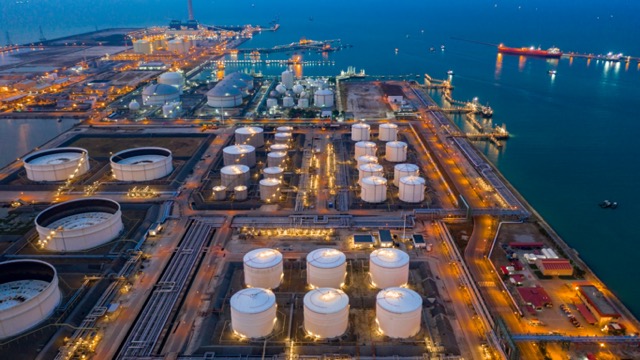
 Aerial view oil treminal with storage tank farm, offshore oilrig, tanker and port, land oil rig, refinery plant, factory, gas station, Business petroleum fuel and gas transport by tanker ship vessel.
For over a century, the economic script written for Africa has been painfully simple, yet devastatingly effective: export the raw, import the refined. It is a structural dependency that has defined the continent’s post-colonial era. This dependency drains national reserves, fuels inflation, and stunts industrial growth. For decades, the Gulf of Guinea was viewed merely as a source of high-quality “Sweet” crude for the Global North. Meanwhile, the people living atop these reserves queued for hours at petrol stations for imported fuel. Today, on the marshlands of Nigeria’s Lekki peninsula, that script is finally being torn apart.
The operationalization of the $19 billion Dangote Petroleum Refinery, boasting a capacity of 650,000 barrels per day, is far more than an industrial milestone. Instead, it represents a profound shift in the geopolitical and economic architecture of the Global South. By effectively ending West Africa’s reliance on European and American refined fuels, the facility is engineering a transition from passive extraction to active economic sovereignty.
The Historical Paradox of the “Structural Sink”
To understand the magnitude of this shift, one must look at the historical paradox of the African oil market. For decades, Nigeria, the continent’s largest crude producer, operated as a massive “structural sink.” The nation pumped millions of barrels of crude daily. However, it spent billions of dollars annually importing premium-priced gasoline and diesel from refineries in Rotterdam and the U.S. Gulf Coast.
This dynamic was not merely an economic inefficiency; it was a textbook manifestation of neo-colonial trade patterns. It trapped African economies in a perpetual loop of foreign exchange depletion and “imported inflation.” When the Naira or the CFA Franc weakened against the Dollar, the cost of energy skyrocketed, even though the oil was sourced from African soil. As a result, the highest-value segment of the energy supply chain, refining and petrochemicals, remained firmly outside the continent.
Technological Sovereignty and the Nelson Index
The Dangote Refinery disrupts this paradigm through sheer technological superiority. With a Nelson Complexity Index of 10.5, the facility is significantly more sophisticated than the aging refineries found across Europe. This complexity allows it to process a variety of crude grades into premium-grade Euro-V diesel, aviation fuel, and petrol.
In early 2026, data confirmed the long-awaited reversal: Nigeria crossed the threshold to become a net exporter of refined petroleum products. By reaching over 93 percent utilization this March, the refinery has effectively neutralized the “refining gap” that has plagued West Africa since 1960. This isn’t just about fuel; it is about the production of polypropylene and specialized lubricants that form the backbone of modern industrialization. Now, we are seeing the birth of a localized value chain. This keeps the profit, the product, and the power on the continent.
The Power of Indigenous Scaling
What is equally crucial is the nature of the capital behind this achievement. This is not a product of conditional Western aid, nor is it driven by foreign immigrant investors dictating terms from afar. Instead, it is a triumph of indigenous Nigerian entrepreneurship operating at a hyper-global scale.
As a researcher who has focused on the mechanics of Nigerian entrepreneurship, I see this as a decolonial masterstroke. It proves that domestic capital, when mobilized with long-term vision, can execute mega-projects capable of challenging entrenched transatlantic monopolies. By bypassing the traditional “Western method” of project financing and oversight, the Dangote Group has asserted a raw, opaque sovereignty. This new approach prioritizes continental stability over shareholder dividends in London or New York.
The ‘Atlantic Buffer’ in a Time of Global Crisis
The refinery’s timing could not be more critical. As U.S. and NATO naval forces confront a near-total paralysis of the Strait of Hormuz, with commercial shipping dropping to near zero following the March 2026 blockade, the global energy map is being redrawn.
As the Persian Gulf remains a militarized no-man’s-land, the shockwaves are being absorbed by this unlikely geopolitical anchor in West Africa. By ending the region’s reliance on European refined products, Dangote has created an “Atlantic Buffer.” Millions of barrels of European and American fuel that would ordinarily have sailed for Lagos are now staying in Western markets. This helps to stabilize a global economy starved of Middle Eastern supply. In a historic shift, African industrial success is providing a safety net for the Global North.
An ‘Africa First’ Economic Axis
The implications ripple across the entire Gulf of Guinea. Driven by an organic “Africa First” strategy, the refinery has already begun fundamentally altering regional supply chains. In the first quarter of 2026 alone, the facility shipped over 450,000 tonnes of refined products to neighboring Côte d’Ivoire, Cameroon, Ghana, and Togo. Furthermore, it recently sent its first shipments to Mozambique. This provides a reliable alternative for East African nations. These nations are currently cut off from their traditional suppliers in the Persian Gulf.
For a scholar based in Yaoundé, seeing Nigerian-refined fuel powering the Cameroonian industry is more than an economic data point; it is a sign of regional integration. This localized distribution network insulates African markets from the extreme volatility of global shipping chokepoints. Moreover, it retains capital within the continent, fostering a macroeconomic stability that was previously impossible.
Decolonizing the Future
As the global energy map undergoes these rapid, often violent transformations, the narrative surrounding Africa is finally catching up to reality. The continent can no longer be viewed merely as a reservoir of raw materials waiting for “expert” processing in the Global North.
The massive steel distillation columns rising above the Lekki peninsula signify the death of the old extractive model. They stand as a testament to a new era of African industrialization. In this era, economic sovereignty is not just debated in academic circles but built, refined, and distributed on African soil. The era of energy dependency is drawing to a close; the era of African industrial sovereignty has officially begun.